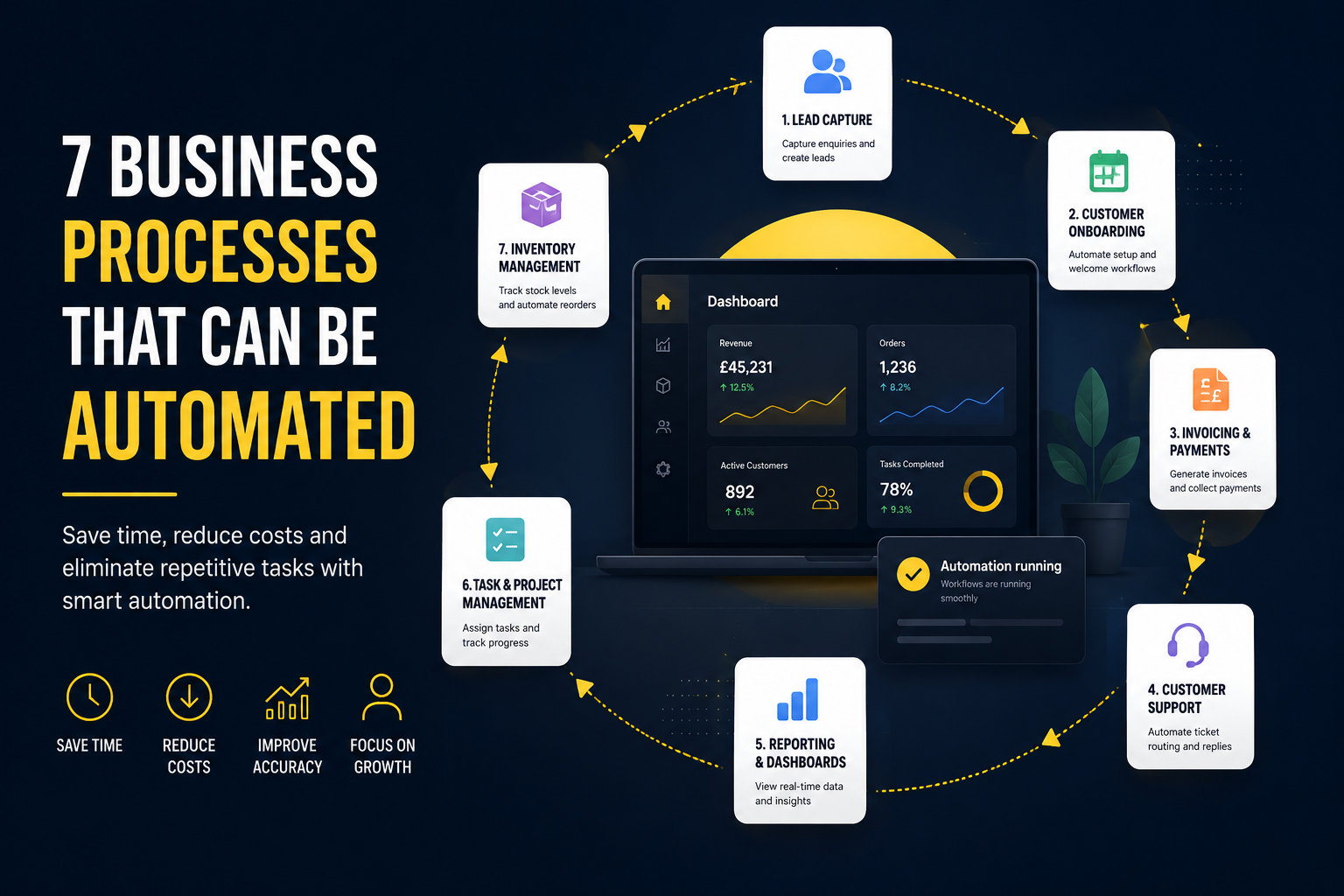
Every business relies on processes to keep things running smoothly. The problem is that many of these processes are still handled manually through spreadsheets, emails, paperwork, and repetitive administrative tasks.
While these methods may work initially, they often become a bottleneck as a business grows. Staff spend hours on repetitive tasks, mistakes become more common, and valuable time is taken away from serving customers or growing the business.
The good news is that many of these processes can be automated using modern software, integrations, and AI-powered tools.
Here are seven common business processes that are ideal candidates for automation.
1. Inventory and Stock Management
The Business Problem
Many businesses still track inventory using spreadsheets or manual stock counts. As stock levels change throughout the day, keeping records accurate becomes increasingly difficult.
This can lead to:
- Running out of stock unexpectedly
- Ordering too much inventory
- Wasted storage costs
- Lost sales opportunities
The Solution
An inventory management system can automatically track stock levels in real-time as products are sold, received, or transferred.
The system can:
- Update stock levels automatically
- Alert staff when inventory is running low
- Generate purchase orders
- Produce stock reports
Real-World Example
An online retailer sells products through its website and marketplace platforms. Instead of manually updating spreadsheets, inventory is updated automatically whenever a sale is made.
When stock reaches a predefined threshold, the system notifies the purchasing team or creates a reorder request automatically.
What I Would Do Differently
Many businesses simply automate stock tracking and stop there.
I would also analyse sales trends and seasonal demand to make smarter purchasing decisions. Selling 20 units per week in February is very different from selling 200 units per week during the Christmas period.
Good automation should help businesses make better decisions, not just complete repetitive tasks faster.
2. Customer Onboarding
The Business Problem
Bringing on a new customer often involves multiple manual steps.
Teams may need to:
- Send contracts
- Create accounts
- Set up project workspaces
- Collect information
- Send welcome emails
When handled manually, the process can become slow and inconsistent.
The Solution
By connecting your systems together, much of the onboarding process can happen automatically.
Once a contract is signed, software can:
- Create customer records
- Generate project spaces
- Send welcome emails
- Request required documents
- Notify team members
Real-World Example
A digital agency automatically creates a client workspace, project board, and shared document folder as soon as a contract is signed.
Instead of spending hours on setup, the team can focus on delivering value.
What I Would Do Differently
Many businesses automate the setup process but forget about communication.
Customers want reassurance after making a purchase.
I would include automated updates that explain what is happening behind the scenes and what the customer can expect next.
3. Invoicing and Payment Collection
The Business Problem
Creating invoices manually and chasing overdue payments takes time and often delays cash flow.
Many businesses rely on someone remembering to:
- Send invoices
- Follow up late payments
- Check payment status
- Update records
The Solution
Modern invoicing systems can automate the entire process.
Invoices can be generated automatically, reminders can be scheduled, and payment status can be tracked without manual intervention.
Real-World Example
A subscription-based business automatically generates monthly invoices and sends reminders if a payment is overdue.
Staff no longer need to spend hours following up payments manually.
What I Would Do Differently
Not every customer should be treated the same.
For high-value clients, I would create workflows that alert account managers before automated reminders are sent, allowing for a more personal approach.
4. Lead Management
The Business Problem
Businesses often receive enquiries through websites, social media, email, and phone calls.
Without a clear process, leads can be forgotten, duplicated, or followed up too late.
The Solution
Lead management systems can automatically:
- Capture enquiries
- Store customer information
- Assign leads to staff
- Schedule follow-ups
- Track sales progress
Real-World Example
A potential customer completes a contact form on a website.
The system creates a lead record, notifies the sales team, and schedules a follow-up task automatically.
What I Would Do Differently
Many businesses focus on collecting leads but don’t focus enough on lead quality.
I would introduce scoring systems that help sales teams prioritise the most promising opportunities first.
5. Employee Offboarding
The Business Problem
When employees leave a company, access to systems, applications, and data often needs to be removed manually.
Missing even one account can create security risks.
The Solution
Automation can ensure access is removed across all connected systems as soon as an employee leaves.
This reduces risk and improves security.
Real-World Example
An employee leaves the business and their access to email, internal systems, project tools, and company resources is automatically revoked.
What I Would Do Differently
I would also automate the transfer of responsibilities to ensure projects, customer accounts, and tasks continue without disruption.
6. Project Reporting
The Business Problem
Managers often spend hours compiling reports from different systems.
By the time the report is finished, the information may already be outdated.
The Solution
Live dashboards can automatically pull information from multiple systems and present it in real-time.
Real-World Example
A project manager can view budgets, deadlines, progress, and team performance from a single dashboard instead of manually creating reports.
What I Would Do Differently
I would combine dashboards with automated summaries delivered by email or messaging platforms so key stakeholders receive important updates without needing to log in.
7. Customer Support Requests
The Business Problem
As businesses grow, customer enquiries become harder to manage.
Important requests can get buried beneath routine questions.
The Solution
Support systems can automatically categorise, prioritise, and assign requests to the correct team members.
AI can also assist by answering common questions before human intervention is required.
Real-World Example
A customer submits a support request through a portal.
The system automatically identifies the issue type, assigns it to the correct team, and updates the customer on progress.
What I Would Do Differently
Rather than replacing support staff with AI, I would use AI to support them.
Providing agents with customer history, account information, and suggested solutions often delivers better results than forcing customers to interact with a chatbot.
Final Thoughts
Automation isn’t about replacing people. It’s about removing repetitive work so teams can focus on higher-value activities.
Businesses that automate the right processes often see improvements in efficiency, customer experience, accuracy, and scalability.
If your team spends hours updating spreadsheets, copying data between systems, creating reports, or managing repetitive tasks, there is a good chance those processes can be improved through automation.
The question is not whether automation is possible. The question is how much time and money your business could save by implementing it.
Need Help Automating Business Processes?
Many businesses waste hours every week on repetitive administrative tasks, disconnected systems and manual workflows.
I help businesses build custom software, automate processes and integrate existing systems to improve efficiency and support growth.