One of the most common questions businesses ask when planning a new website or software project is:
“Should we use WordPress or build something custom with Laravel?”
Unfortunately, there isn’t a single correct answer.
Both Laravel and WordPress are powerful platforms used by businesses around the world, but they solve different problems. Choosing the wrong tool can lead to unnecessary costs, technical limitations, and expensive rebuilds later on.
The goal shouldn’t be to choose the most popular technology. The goal should be to choose the technology that best supports your business objectives.
Let’s explore where each platform excels and how to determine which one is right for your project.
Understanding the Difference
Before comparing the two, it’s important to understand what they were designed to do.
What is WordPress?
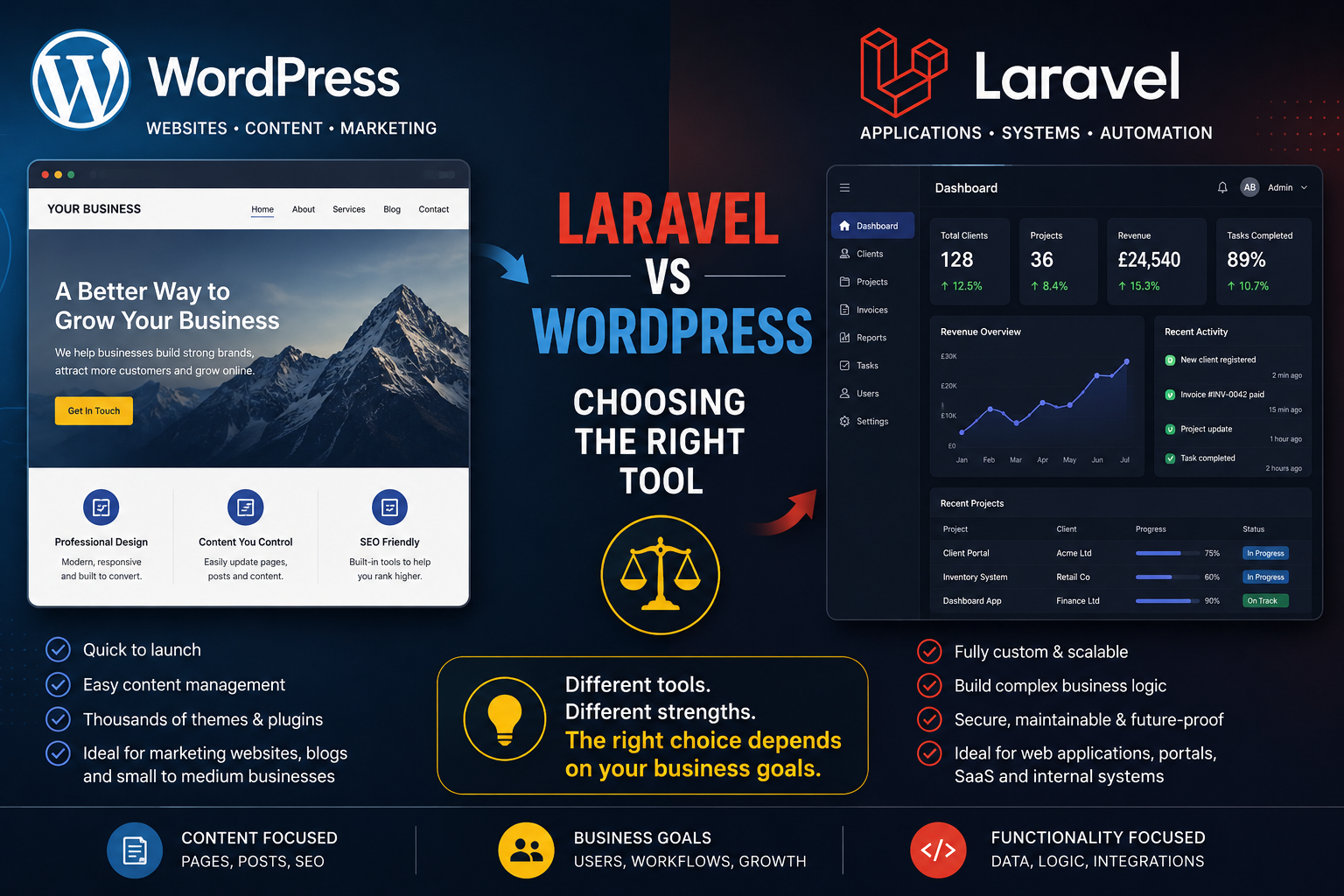
WordPress is a content management system (CMS).
It was originally created for blogging but has evolved into a platform capable of powering:
- Business websites
- Marketing websites
- Blogs
- Membership sites
- Online stores
- Portfolio websites
Its biggest strength is allowing non-technical users to manage content without needing development expertise.
What is Laravel?
Laravel is a PHP application framework.
Rather than providing a ready-made website, Laravel provides the tools developers need to build custom software applications from the ground up.
Laravel is commonly used for:
- Business applications
- Client portals
- SaaS products
- Internal systems
- Dashboards
- Workflow automation
- API platforms
Laravel prioritises flexibility and customisation over speed of setup.
When WordPress Makes Sense
The Business Problem
You need a professional website quickly and cost-effectively.
You want to:
- Publish content
- Manage pages
- Generate leads
- Improve SEO
- Make updates yourself
Why It Matters
Most businesses don’t need custom software.
If your primary goal is marketing your business online, WordPress is often the fastest and most cost-effective solution.
Real-World Example
A local accounting firm needs:
- A homepage
- Service pages
- Blog functionality
- Contact forms
- SEO optimisation
WordPress can deliver all of these requirements without building a custom application.
What I Would Do Differently
Many businesses install dozens of plugins to achieve every new feature request.
While this works initially, excessive plugin usage often creates performance, security, and maintenance issues.
I would focus on keeping the solution simple and only introducing custom development where it genuinely adds value.
When Laravel Makes Sense
The Business Problem
Your business processes cannot be solved using a standard website.
You need custom functionality.
Why It Matters
As businesses grow, they often require systems that are unique to how they operate.
Examples include:
- Client portals
- Booking systems
- Inventory management
- Reporting dashboards
- Workflow automation
- Membership platforms
- Internal business tools
These solutions usually require more flexibility than WordPress can comfortably provide.
Real-World Example
A logistics company needs a platform where customers can:
- Track deliveries
- View invoices
- Download documents
- Submit requests
- Access reports
This is not a typical website.
This is a business application.
Laravel is a much better fit for this type of project.
What I Would Do Differently
Some businesses try to force complex business applications into WordPress because it appears cheaper initially.
In many cases, this results in a collection of plugins and workarounds that become difficult to maintain.
If the project is fundamentally a software application rather than a website, I would start with Laravel from day one.
Comparing Common Business Scenarios
Marketing Website
Recommended: WordPress
If your primary goal is content, lead generation, and search engine visibility, WordPress is usually the better choice.
Business Blog
Recommended: WordPress
Content management is one of WordPress’s greatest strengths.
E-Commerce Store
Recommended: WordPress or Laravel
For standard online stores, WooCommerce is often sufficient.
For highly customised purchasing workflows, Laravel may provide greater flexibility.
Client Portal
Recommended: Laravel
Portals often require:
- Authentication
- Permissions
- Dashboards
- Document management
- Custom workflows
Laravel handles these requirements extremely well.
Internal Business System
Recommended: Laravel
Internal tools are rarely standardised.
Custom development usually provides a better long-term solution.
SaaS Platform
Recommended: Laravel
Most SaaS products require complete control over business logic, data structures, subscriptions, permissions, and integrations.
Laravel was built for exactly this type of work.
Cost Considerations
Many businesses assume WordPress is always cheaper.
This isn’t always true.
Short-Term Cost
WordPress generally wins.
Projects can often be launched faster because many features already exist.
Long-Term Cost
The answer depends on the project.
A simple marketing website may remain affordable on WordPress for years.
A complex system built with dozens of plugins may eventually become more expensive than a properly designed Laravel application.
What I Would Do Differently
Rather than focusing solely on development cost, I would evaluate:
- Maintenance costs
- Future requirements
- Scalability
- Security
- Operational efficiency
The cheapest solution today isn’t always the cheapest solution in three years.
The Biggest Mistake Businesses Make
The most common mistake isn’t choosing Laravel.
The most common mistake isn’t choosing WordPress.
The biggest mistake is choosing technology before understanding the business problem.
Businesses often start with questions like:
- Should we use WordPress?
- Should we use Laravel?
- Should we use React?
The better question is:
What problem are we trying to solve?
Once the problem is clearly understood, the appropriate technology becomes much easier to identify.
Final Thoughts
WordPress and Laravel are both excellent tools.
The difference is that they are designed for different purposes.
If you need a content-driven website, WordPress is often the fastest and most cost-effective solution.
If you need custom software, business automation, client portals, dashboards, or SaaS functionality, Laravel is usually the better choice.
The goal isn’t to pick a winner.
The goal is to choose the right tool for the job.
The best technology decision is the one that supports your business objectives today while providing enough flexibility for future growth.
Not Sure Which Platform Is Right for Your Project?
Choosing the wrong platform can create unnecessary costs, technical limitations and expensive rebuilds as your business grows.
Whether you’re planning a marketing website, client portal, business application or custom software solution, the most important decision isn’t the technology—it’s understanding the problem you’re trying to solve.
I help businesses evaluate requirements, choose the right technology stack and build solutions that support both current needs and future growth.