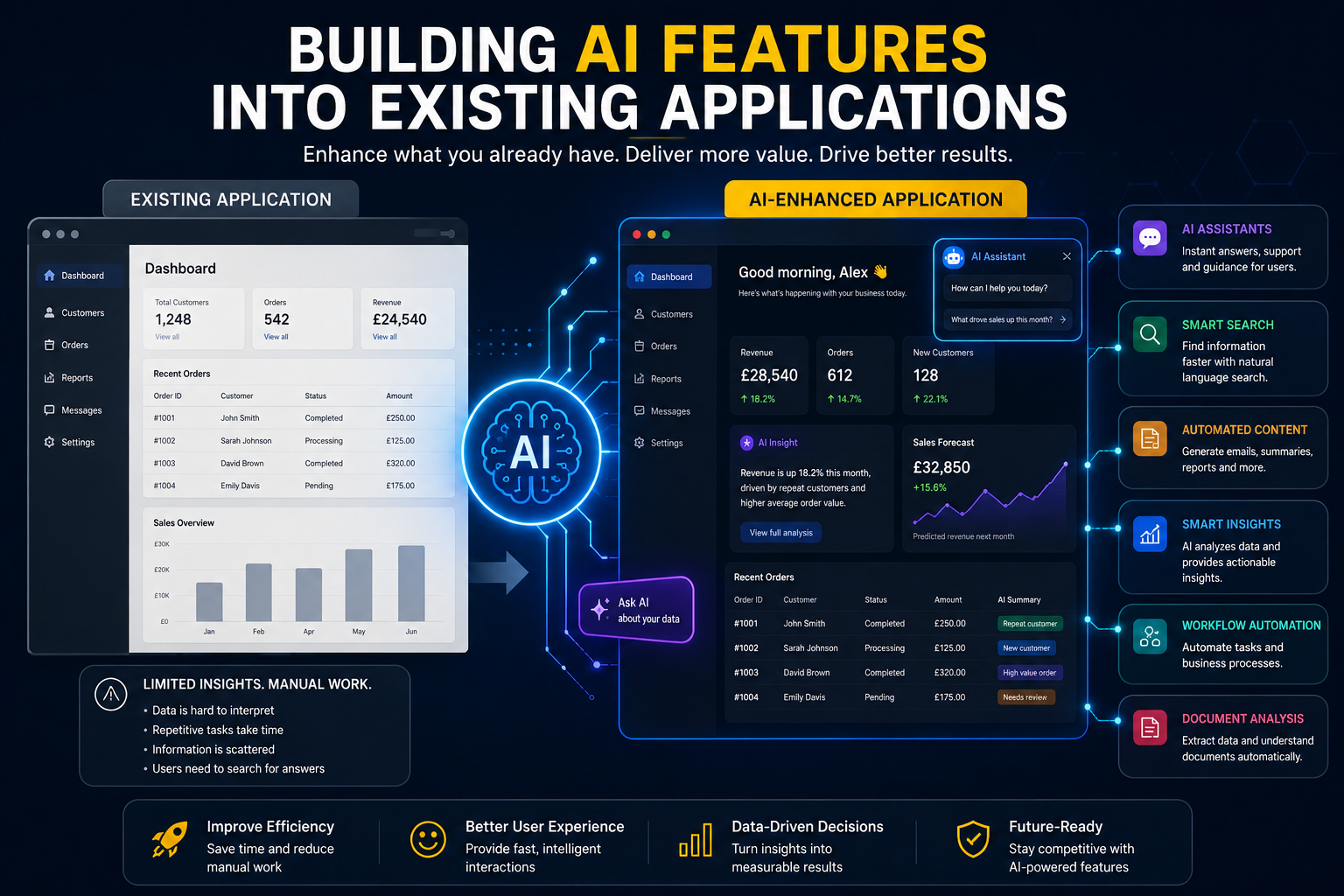
Artificial Intelligence is no longer reserved for large technology companies.
Today, businesses of all sizes are exploring how AI can improve customer experiences, automate repetitive tasks, and help employees work more efficiently.
However, one of the biggest misconceptions about AI is that businesses need to build entirely new systems to benefit from it.
In reality, some of the most valuable AI projects involve enhancing existing applications rather than replacing them.
Whether it’s a client portal, CRM system, internal dashboard, booking platform, or customer support system, AI can often be integrated into software businesses already use every day.
Let’s explore some practical ways AI features can be added to existing applications and where they can deliver real business value.
1. AI-Powered Customer Support
The Business Problem
Customer support teams often spend a large portion of their time answering the same questions repeatedly.
Common requests include:
- Password resets
- Order tracking
- Account information
- Pricing enquiries
- Basic troubleshooting
While these questions are important, they can consume valuable support resources.
The Solution
AI assistants can provide instant answers to common questions directly within an application.
Instead of waiting for a support agent, users can receive assistance immediately.
Real-World Example
A client portal includes an AI support assistant trained on company documentation, FAQs, and knowledge base articles.
Customers receive answers within seconds without needing to submit a support ticket.
What I Would Do Differently
Many businesses try to replace support teams with AI.
I would use AI to support human agents rather than replace them.
Complex issues still require human expertise, but AI can handle repetitive enquiries and provide agents with relevant information faster.
2. Intelligent Search and Knowledge Bases
The Business Problem
Many applications contain large amounts of information that users struggle to find.
Traditional search systems rely on exact keywords and often return poor results.
The Solution
AI-powered search allows users to ask questions naturally.
Instead of searching for specific keywords, users can simply describe what they are looking for.
Real-World Example
An internal company knowledge base contains policies, procedures, and training materials.
Employees can ask:
“How do I request annual leave?”
and receive the relevant information instantly.
What I Would Do Differently
Rather than allowing AI to answer from the internet, I would restrict responses to approved company documentation.
This reduces inaccuracies and ensures employees receive reliable information.
3. Automated Content Generation
The Business Problem
Creating content often requires significant time and effort.
Businesses regularly need:
- Product descriptions
- Reports
- Emails
- Meeting summaries
- Internal documentation
The Solution
AI can generate draft content directly inside existing applications.
Users remain in control while reducing the amount of manual writing required.
Real-World Example
A CRM platform automatically generates follow-up email drafts based on previous customer interactions.
Sales staff review and send the message rather than writing it from scratch.
What I Would Do Differently
I would treat AI-generated content as a starting point rather than a final output.
Human review remains essential for quality and accuracy.
4. Smart Reporting and Insights
The Business Problem
Businesses collect large amounts of data but often struggle to interpret it.
Dashboards provide information, but not always understanding.
The Solution
AI can analyse business data and explain trends in plain English.
Instead of manually interpreting charts and graphs, users receive clear summaries and recommendations.
Real-World Example
A business dashboard reports:
Revenue increased by 18% this month, primarily driven by repeat customers and increased order values.
Rather than simply displaying numbers, the system provides context.
What I Would Do Differently
I would focus on actionable insights rather than generating large amounts of analysis.
Decision-makers need clarity, not more information.
5. Workflow Automation
The Business Problem
Many business processes still rely on manual decisions and repetitive actions.
Examples include:
- Reviewing forms
- Categorising requests
- Assigning tasks
- Routing enquiries
The Solution
AI can help classify information and trigger workflows automatically.
Real-World Example
A customer submits a support request.
The AI analyses the request, determines its category and urgency, and routes it to the appropriate department.
What I Would Do Differently
I would always provide human oversight for important business decisions.
AI should assist workflows, not become the sole decision-maker.
6. AI Assistants for Internal Teams
The Business Problem
Employees often waste time searching for information, switching between systems, or asking colleagues questions that have already been answered.
The Solution
An AI assistant can act as a central point of access for company information.
Employees can ask questions and receive answers from connected systems and documentation.
Real-World Example
A project manager asks:
“Which projects are currently behind schedule?”
The assistant retrieves information from the project management system and presents a summary.
What I Would Do Differently
I would integrate the assistant with existing business systems rather than creating another standalone tool employees need to learn.
7. Document Analysis and Data Extraction
The Business Problem
Many organisations still process invoices, forms, contracts, and documents manually.
The Solution
AI can extract information automatically and populate business systems with structured data.
Real-World Example
An invoice is uploaded to a portal.
The AI extracts supplier information, invoice numbers, dates, and totals before creating a draft accounting record.
What I Would Do Differently
I would always include validation workflows for important financial or legal documents.
AI should reduce workload, not remove quality control.
The Biggest Mistake Businesses Make
One of the most common mistakes businesses make is implementing AI because it feels innovative rather than because it solves a real problem.
Many AI projects fail because they start with:
“How can we use AI?”
instead of:
“What problem are we trying to solve?”
Successful AI projects focus on measurable outcomes such as:
- Reducing support workload
- Improving response times
- Increasing productivity
- Improving customer experience
- Eliminating repetitive tasks
The technology itself is secondary.
Final Thoughts
The most valuable AI solutions are often the ones users barely notice.
Rather than replacing entire systems, AI can enhance existing applications by making them faster, smarter, and easier to use.
Businesses don’t necessarily need a new platform to benefit from AI.
In many cases, the biggest opportunities come from integrating AI into the tools employees and customers already use every day.
The goal isn’t to add AI for the sake of it.
The goal is to solve real business problems more effectively.
Looking to Add AI Features to Your Existing Software?
Many businesses already have systems that work well but could be improved with intelligent automation, AI-powered search, smart reporting, or customer support assistants.
I help businesses identify practical AI opportunities and integrate AI features into existing applications, portals, dashboards and business systems.