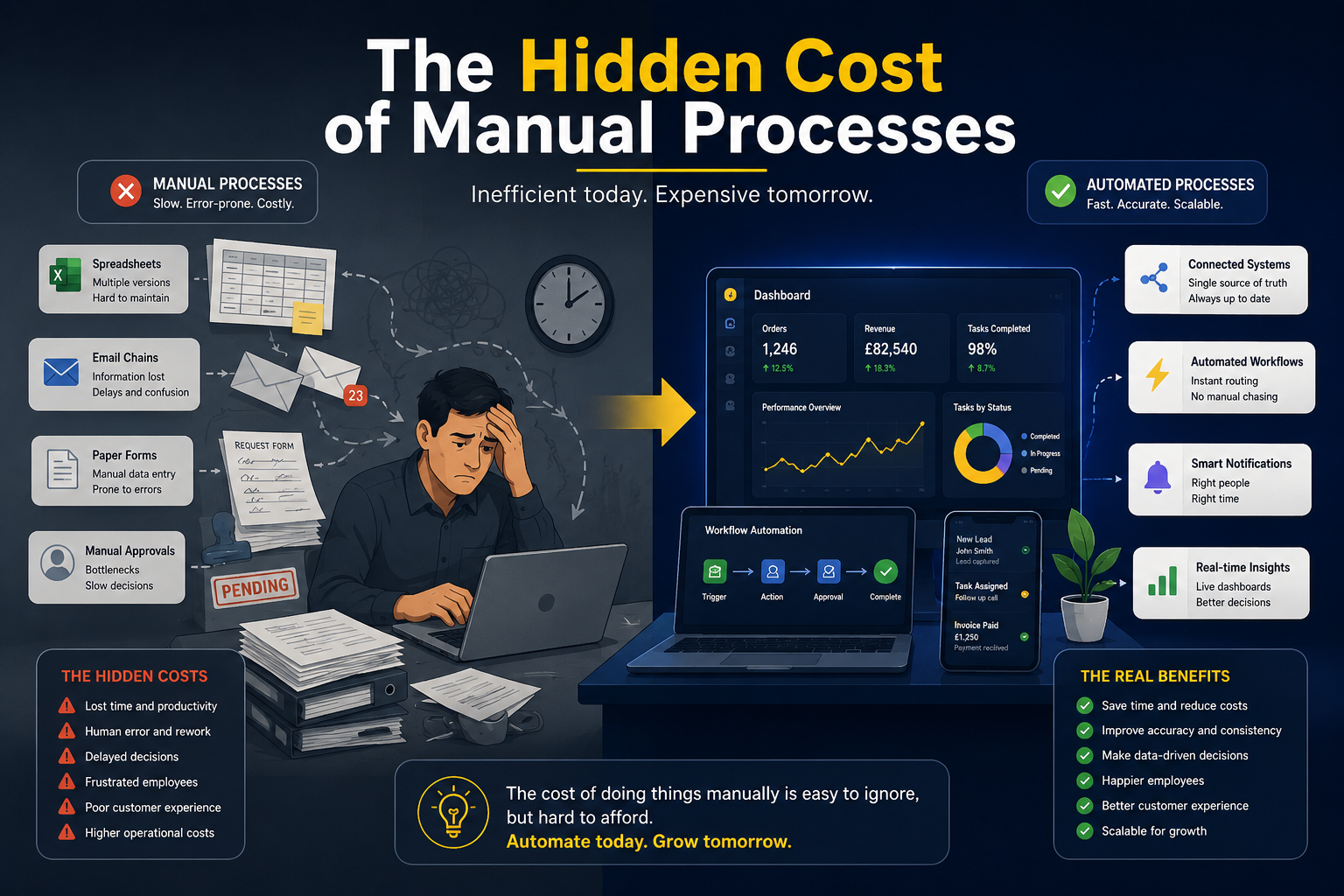
Most businesses don’t wake up one morning and decide to run inefficient operations.
Manual processes usually develop gradually. A spreadsheet is created to solve a quick problem. A member of staff builds a workaround. An email chain becomes the unofficial approval system. Before long, critical business operations depend on a collection of disconnected tools, repetitive tasks, and tribal knowledge.
At first, these processes appear harmless.
The problem is that the true cost isn’t always visible.
While businesses often focus on obvious expenses such as salaries, software subscriptions, and office costs, manual processes create hidden operational costs that can quietly slow growth, reduce productivity, and impact profitability.
Let’s explore where those hidden costs come from and what businesses can do differently.
1. Time Lost to Repetitive Administrative Work
The Business Problem
Many employees spend a significant portion of their day performing repetitive administrative tasks.
Examples include:
- Copying information between systems
- Updating spreadsheets
- Creating reports
- Sending routine emails
- Chasing approvals
Individually, these tasks may only take a few minutes.
Collectively, they can consume hundreds of hours every month.
Why It Matters
When skilled employees spend their time on repetitive administration, they are not spending that time serving customers, improving processes, generating sales, or delivering projects.
The business is effectively paying highly skilled people to perform low-value work.
Real-World Example
A project manager spends two hours every Friday collecting updates from multiple systems and manually producing a status report for stakeholders.
Across a year, that equates to more than 100 hours spent producing reports rather than managing projects.
What I Would Do Differently
Instead of asking people to manually gather information, I would build automated dashboards that collect data directly from the source systems.
The goal isn’t simply to save time. It’s to allow employees to focus on activities that create value for the business.
2. Human Error and Data Inconsistency
The Business Problem
Manual processes depend on people entering, updating, and transferring information correctly.
Unfortunately, mistakes happen.
Data can be:
- Entered incorrectly
- Duplicated
- Lost
- Outdated
- Stored in multiple locations
Why It Matters
Poor data quality affects decision-making.
When reports are inaccurate or systems contain conflicting information, managers can make decisions based on incorrect assumptions.
Real-World Example
A sales team maintains customer information in a CRM while finance maintains separate customer records in spreadsheets.
Over time, the two systems drift apart, creating confusion and unnecessary administrative work.
What I Would Do Differently
Rather than allowing data to exist in multiple places, I would create a single source of truth and automate the flow of information between systems.
Good software reduces the number of opportunities for human error.
3. Delays Caused by Approval Bottlenecks
The Business Problem
Many organisations rely on manual approval processes.
Requests are sent via email, paperwork is passed between departments, and important decisions wait for someone to respond.
Why It Matters
Small delays quickly accumulate.
Projects take longer to complete.
Customers wait longer for responses.
Opportunities are missed.
Real-World Example
A customer requests a refund.
The request must pass through three different departments before approval can be granted.
What could take minutes ends up taking several days.
What I Would Do Differently
I would automate approval workflows with predefined rules and notifications.
The right people receive the right information at the right time without relying on lengthy email chains.
4. Poor Customer Experience
The Business Problem
Customers rarely see internal processes.
What they do see are the consequences.
Slow response times, missing information, delayed deliveries, and inconsistent communication are often symptoms of inefficient manual processes.
Why It Matters
Customers compare their experience with the best businesses they interact with.
If your processes create friction, customers will notice.
Real-World Example
A customer submits an enquiry through a website.
The enquiry sits in a shared inbox for two days because nobody realised it had arrived.
The customer contacts a competitor instead.
What I Would Do Differently
I would automate lead capture, notifications, and customer communication so enquiries are acknowledged immediately and routed to the correct person.
5. Difficulty Scaling Operations
The Business Problem
Many businesses attempt to grow by adding more people rather than improving processes.
As workload increases, additional staff are hired simply to manage administration.
Why It Matters
Growth becomes expensive.
Revenue may increase, but operational costs increase at the same rate.
Real-World Example
A company processes customer orders manually.
As order volume doubles, they hire additional administrative staff to keep up.
The process itself never improves.
What I Would Do Differently
Before hiring additional staff, I would examine which parts of the workflow could be automated.
The most scalable businesses improve systems before increasing headcount.
6. Lack of Visibility and Reporting
The Business Problem
When information is spread across spreadsheets, inboxes, and disconnected systems, gaining a clear picture of business performance becomes difficult.
Why It Matters
Managers need accurate information to make informed decisions.
Without visibility, problems are often discovered too late.
Real-World Example
A business discovers a decline in customer satisfaction months after it began because reporting was compiled manually and reviewed infrequently.
What I Would Do Differently
I would implement live dashboards and automated reporting so key metrics are always visible and decision-makers have access to real-time information.
7. Employee Frustration and Burnout
The Business Problem
Few people enjoy repetitive administrative work.
Employees become frustrated when they spend their day performing tasks that could easily be automated.
Why It Matters
Frustration leads to lower engagement, reduced productivity, and higher staff turnover.
Replacing experienced employees is often far more expensive than improving inefficient processes.
Real-World Example
Customer service staff repeatedly enter the same customer information into multiple systems because none of the systems communicate with each other.
Over time, morale declines and mistakes become more common.
What I Would Do Differently
I would focus on eliminating repetitive tasks and reducing friction wherever possible.
Technology should support employees, not create additional work for them.
The Bigger Picture
The true cost of manual processes is rarely visible on a financial report.
It appears in the form of:
- Lost productivity
- Delayed decisions
- Poor customer experiences
- Employee frustration
- Missed opportunities
- Slower growth
Individually, these issues may seem minor.
Combined, they can have a significant impact on a business’s ability to compete and scale.
Final Thoughts
Most businesses don’t have a technology problem.
They have a process problem.
The goal isn’t to automate everything. The goal is to identify repetitive, time-consuming, and error-prone activities that prevent people from doing their best work.
By improving workflows, integrating systems, and introducing automation where it makes sense, businesses can reduce costs, improve efficiency, and create a better experience for both employees and customers.
The question isn’t whether manual processes are costing your business money.
The question is whether you know how much they’re costing.
Need Help Improving Inefficient Business Processes?
Many businesses lose valuable time every week to repetitive administrative tasks, disconnected spreadsheets, manual data entry and inefficient workflows.
Whether you’re struggling with reporting, customer onboarding, inventory management, approvals or internal processes, the right software can help eliminate bottlenecks and improve efficiency.
I help businesses design and build custom software, automate workflows and integrate existing systems to reduce manual work and support long-term growth.